There is a version of a goodbye that only exists on the last day.
The coffee is already made because you both know how the other takes it now.
The bag is packed by the door, but nobody is in a hurry to open it.
Somebody says "text me when you land" and means it, not as a formality, but as a promise they fully intend to keep.
And underneath the small talk, there is a lump in your throat that makes zero logical sense, because you have known this person for exactly ninety six hours.
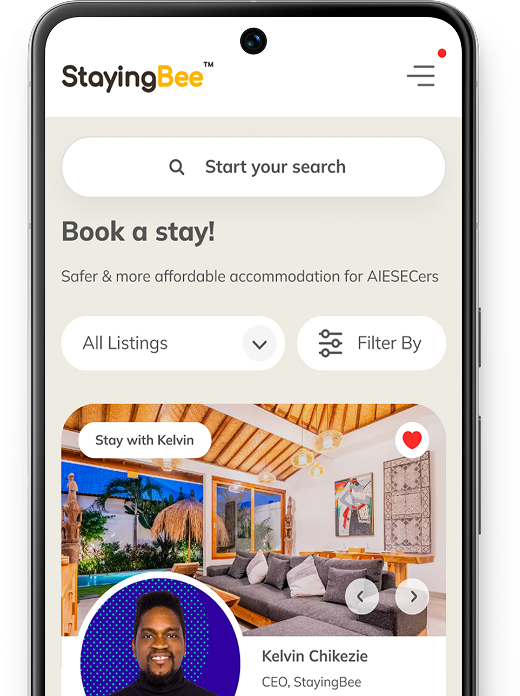
If you have ever hosted or travelled with StayingBee, you know this morning. You have lived it in a kitchen in Helsinki, on a balcony in Bucharest, over a shared pot of tea in Berlin.
And if you have felt that specific ache, the one that seems too big for how little time you actually spent together, you have probably wondered the same thing everyone wonders.
Why does this hurt so much? We just met.
See that’s the thing about fast, real connection: it does not downscale its feelings just because the timeline was short.
A friendship built over four days in someone's actual home, cooking in their kitchen, meeting their neighbours, hearing the story behind the photo on their wall, can carry more weight than an acquaintance you have technically known for four years.
That is not a flaw. That is just how closeness works when you strip away the small talk and the transactional distance of a hotel checkout.
Most travel is designed to protect you from ever feeling this. Hotels are built so you never have to say goodbye to anyone, because you never really said hello.
Even Airbnb, for all its convenience, mostly keeps host and guest at arm's length: a lockbox, a key code, a review left for strangers who will stay strangers.
StayingBee was not built for that kind of distance. It was built for the opposite.
For a host opening their front door.
For a guest becoming part of someone's life for a few days. And when you build something around real proximity, real trust, and real time spent together, the real feelings that come with it is inevitable.
So when that last morning hits, (and it always hits), it is not a sign that something went wrong. It is a sign that something went exactly right.
That lump in your throat is data. It is proof that you were not just occupying a room, but you were part of someone's week.
That the conversations were not filler but they were real and somewhere between the second night and the third, a host stopped being "the person renting me a couch" and started being someone you would genuinely miss.
Guests describe it as leaving with a story instead of just a stamp in a passport. Hosts describe it as their home feeling a little quieter for a few days after someone leaves. Both of those are the same feeling, just standing on opposite sides of the same front door.
That is the entire premise StayingBee is built on: that travel should feel like something, not just look good in photos. That a stay should be able to change you a little, even a short one. Especially a short one.
It would be easier, honestly, to build a platform that keeps everyone at a safe emotional distance. Easier to optimize for convenience over connection, for check-in codes over conversation. But StayingBee is not trying to be easier. It is trying to be realer.
So the ache on the last morning is not something we are trying to design away. It is the whole point. It means the model is doing exactly what it was meant to do: turning strangers into people who matter to each other, even briefly, even four days at a time.
If you have felt that ache before, you already know what it is worth. And if you have not felt it yet, there is a front door somewhere with your name on it, or a guest room somewhere in the world waiting for you to walk through it.
As a guest: somewhere out there is a last morning waiting for you, a kitchen you have not sat in yet, a person you have not said goodbye to yet. and go find it.
As a host: you don't need a spare room in a big city to give someone that feeling. You just need to open the door. and get ready for your own last morning, coffee included.