You've been overpaying for your last few trips, and we can prove it.
Because here's the thing about booking travel: the sticker price is a lie.
Not maliciously, just structurally. What you see on page one is rarely what leaves your account by checkout.
So we did the math for you, on a fairly typical 5-night trip to a mid-range European city, using real 2026 pricing data.
Grab a coffee. This gets interesting.
Mid-range hotels in popular European cities are currently averaging somewhere around $120-150 a night for a standard double room. Let's call it $130.
- 5 nights × $130 = $650
- City/tourist tax (typically $2-4/night) = ~$15
- Total: around $665
No huge surprises here. Hotels are refreshingly upfront about what you're paying for.
The catch, however, is what you're not getting: a person. A recommendation. Someone to tell you the 8am breakfast buffet is a war zone and the café two streets over is better and cheaper.
All you get is a key card and a "have a nice stay."
This is where it gets sneaky. Airbnb's advertised nightly price is basically a teaser trailer for the real total.
- Average nightly rate for an entire-place listing in a popular city: ~$140
- 5 nights × $140 = $700
- Guest service fee (typically 14-16% of the subtotal) = ~$105
- Cleaning fee (a flat one-time charge, regardless of how long you stay): ~$60
- Total: around $865
Notice that cleaning fee doesn't care if you're staying one night or ten — it just sits there, quietly making short trips proportionally more expensive.
And that service fee wasn't on the price you searched for. It shows up right at checkout, like an uninvited party guest.
So for the same five nights, you're paying about $200 more than the hotel — for a stay where, statistically speaking, you'll never meet your host, and they'll never meet you.
Here's where the math stops being about fees and starts being about a completely different model.
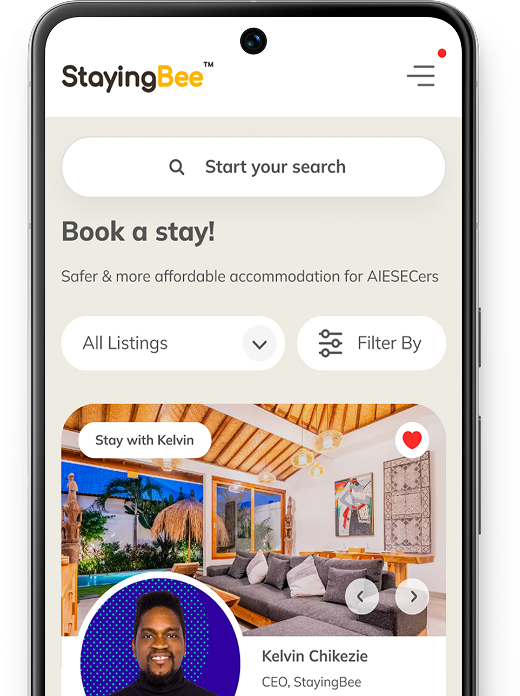
StayingBee isn't pricing accommodation like a business renting out inventory. It's your AIESEC, Erasmus, CEMS, JCI, Enactus, or Rotary network opening their doors to you.
Some hosts set a modest nightly rate.
Some ask for nothing at all beyond good company and maybe a home-cooked dinner together. There's no guest service fee stacked on top, no cleaning fee sprung on you at checkout, no algorithm quietly testing how much more you'll tolerate paying this week.
One StayingBee guest put it simply:
The price point was good enough that it let me extend my trip.
Even on the higher end, five nights through StayingBee typically costs less than a single night at the hotel — and that's before you count what you're actually getting: a local who already gets you, and has insider recommendations no listing description can fake, and the particular, hard-to-manufacture comfort of staying somewhere that feels less like a transaction and more like a favour between friends.
But the real savings here aren't only financial. There are costs no price breakdown captures. The ones you only notice by their absence:
The cost of a forgettable trip. A hotel room in any city looks like a hotel room in every city. An Airbnb, however nicely decorated, is still a stranger's apartment with your name on the booking.
A StayingBee host is a person who already shares your language, your values, your reference points — which means your trip stops being "days spent in a city" and starts being "days spent with people."
That's the entire difference between a trip you post about and a trip you actually remember.
The cost of bad recommendations. Every traveller knows the tourist-trap tax — the overpriced meal near the landmark, the "hidden gem" that's hidden because it's mediocre, the hour lost figuring out which bus actually goes where you're going.
A host from your own network skips all of that. They'll tell you which restaurant is worth the wait and which one is a scam, where locals actually hang out, and what to skip entirely — the kind of insight that no algorithm or star rating can replicate, because it comes from someone who lives there and already wants you to have a good time.
The cost of feeling unsafe. This one matters most for solo travellers.
Booking a stranger's spare room, especially alone and especially in an unfamiliar city, carries a quiet background hum of caution that never fully switches off — reading between the lines of reviews, double-checking the neighbourhood, keeping location sharing on just in case.
Staying with someone verified through your own community changes that entirely.
You're not gambling on a stranger's profile photo; you're staying with someone who's answerable to the same network you are.
That kind of peace of mind isn’t on a receipt, but ask any solo traveller what it's worth, and the answer is usually: everything.
The gap isn't only in the dollars. It's in what those dollars buy you — a transaction versus a connection, a keycard versus a person who already, genuinely, wants you there.
You already know how to read a price breakdown now. So next time you're booking, run it — hotel, Airbnb, and then check who from your network is already in that city, waiting to say yes.
Join StayingBee **** ****and save on what your next trip could actually cost